The Principles of Good Drug Education
Choosing the best approach to drug education is a key task for educators. There is no shortage of guidance, information, and materials but choosing the most relevant and supportive for the group or groups you lead depend on a number of factors.
This page aims to help you understand the principles that lie at the heart of good practice; those that follow have been adapted from the latest best-practice evaluations carried out in the UK, Canada, Australia, the USA, by the United Nations and in other countries.
The Principles
1. Environment: Good drug education is…
? Underpinned by a whole school approach
? Enhanced by family-based prevention programmes
2. Planning: An appropriate curriculum is…
? Relevant and responsive to the developmental stage and circumstances of the children and young people (see Needs Assessment below)
? Taught in the context of other personal, social and health issues.
? Manageable given available resources
? Informed by programmes that produce achievable outcomes
? Developmental: re-visited, consolidated and extended throughout childhood and youth
? Supported by appropriate training
? Evidence based and/or evaluated
3. Practice: The educator…
? Creates a comfortable classroom climate
? Uses interactive teaching styles
? Is responsive to different cultural views and realities
? Includes a normative component
? Keeps up-to-date with evidence
4. Content: The selected materials and activities?
? Explore attitudes to drugs and drug users
? Provide children and young people with opportunities to develop social skills
? Use credible, reliable and up-to-date sources explore, contrast, and, where appropriate, support (or challenge) attitudes to self and others, to drugs, to drug use and non-use – and to drug users and non-users
? Strengthen protective factors
? Minimise risk factors
5. Evaluation: The programme is informed by…
? Assessment
? Monitoring
? Impact evaluation
Frequently Asked Questions
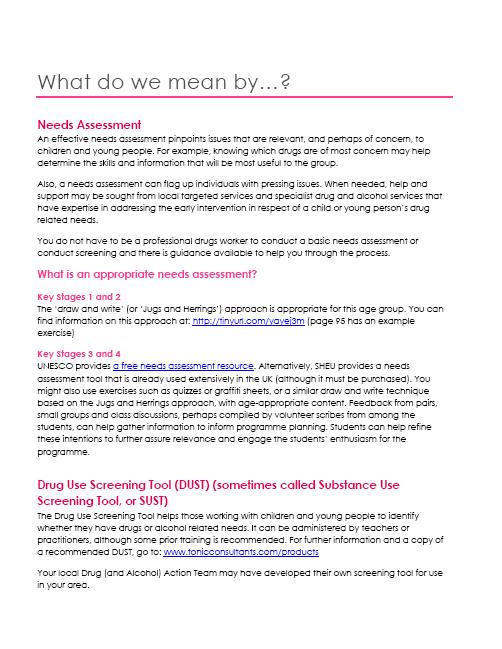
The Drug Education Forum’s answers to FAQs can be downloaded here.
The paper gives answers to questions relating to drug education and commonly used terminology such as needs assessment; normative education and risk and protective factors. Links to further information and resources are provided.
Elements of Effective Drug Education
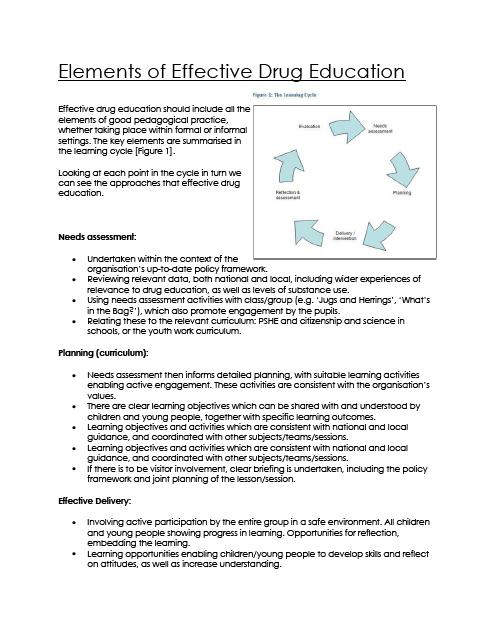
The Drug Education Forum’s paper on the cyle of learning can be downloaded here.
The paper gives guidance on each element of the cycle including needs assessment; planning; delivery/intervention; reflection and assessment; and evaluation.
Advice for Teachers on Delivering Drug Education
 The Drug Education Forum’s paper offering practical advice for teachers on the delivery of drug education can be downloaded here.
The paper contains guidance on the principles of drug education, questions to ask of the school, and of yourself, as well as offering practical tips on teaching and evaluating drug education.